
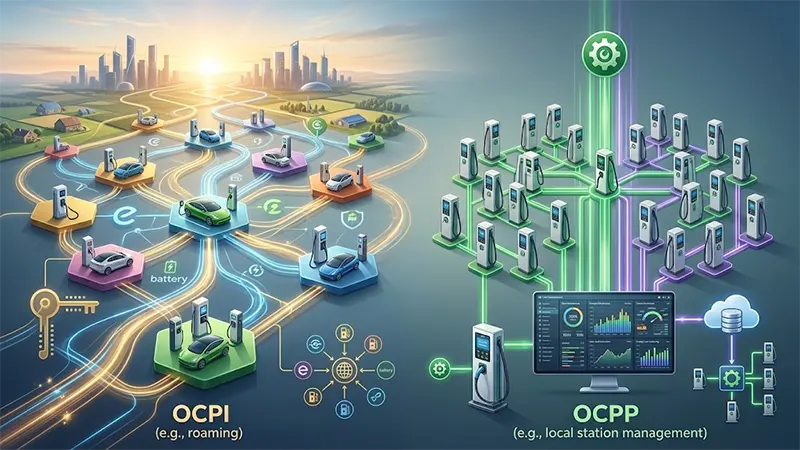
If you’ve spent any time researching EV charging technology, you’ve likely come across two similar-looking acronyms; OCPP and OCPI; often mentioned in the same breath. They are related, but they solve different problems. Put simply, OCPP governs how a charger talks to its own back-end system, while OCPI governs how different charging networks talk to each other.
What is OCPP?
The Open Charge Point Protocol (OCPP) is a communication standard used between a physical EV charger and the charging management system (sometimes called a back-end or CMS) that operates it. It allows the management system to start and stop charging sessions, receive status updates, monitor faults, and push firmware or configuration changes to the charger. Because OCPP is an open, vendor-neutral standard, it allows charging hardware from different manufacturers to work with different back-end software, instead of locking an operator into a single vendor’s proprietary system.
What is OCPI?
The Open Charge Point Interface (OCPI) operates one level up. It enables communication between separate charging networks or service providers, rather than between a charger and its own back end. This is what makes EV roaming possible; a driver from one charging network being able to locate, authenticate, and pay for a session on another network’s chargers. An OCPI EV charging network essentially exposes charger location, availability, and pricing data to partner networks, and handles the session and billing information that roaming requires.
How they work together
| Aspect | OCPP | OCPI |
|---|---|---|
| Primary role | Charger-to-backend communication | Network-to-network communication |
| Connects | Charger hardware and its management system | Separate charging network operators/platforms |
| Main purpose | Remote monitoring, control, and management of individual chargers | Interoperability and roaming across networks |
| Typical use | Starting/stopping sessions, firmware updates, fault reporting | Cross-network authentication, session data exchange, billing |
Neither protocol replaces the other; they operate at different layers of the same ecosystem. A charging station’s OCPP connection lets its own operator manage it; that operator’s platform can separately use OCPI to let drivers from other networks use that same charger. In practice, OCPI EV charging depends on OCPP already working correctly underneath it, since the charger still needs to report accurate status back to its own management system for any roaming session to function.
Why this distinction matters
As charging networks expand and drivers increasingly expect to charge across multiple operators without separate accounts, understanding OCPI vs OCPP helps businesses evaluate charging hardware and software correctly; asking not just “does this charger support OCPP” but also “can this network support OCPI-based roaming” when interoperability is a requirement.
