
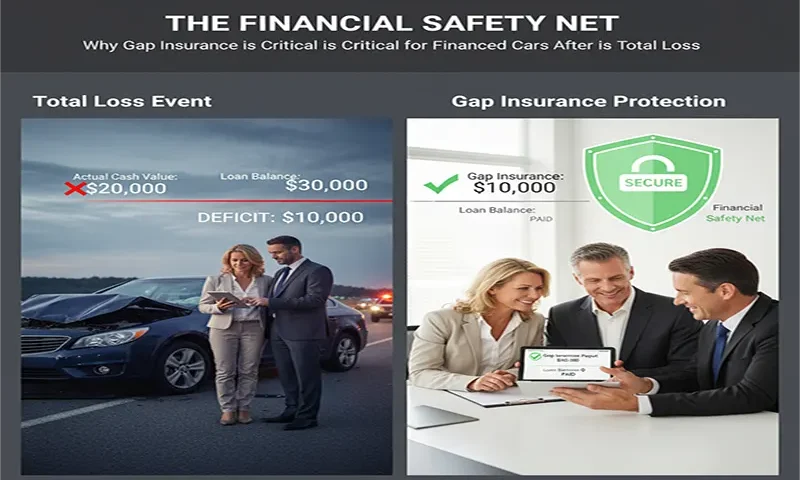
When you finance a vehicle, you are entering into a legal agreement to pay back a specific amount of money, regardless of what happens to the car. Many new car owners operate under the assumption that their comprehensive auto insurance will “make them whole” if the vehicle is totaled. Unfortunately, that is often a costly misconception.
If your vehicle is declared a total loss, your primary insurance provider pays only the Actual Cash Value (ACV)—the fair market value of the car at the time of the accident—not what you paid for it or what you currently owe on your loan. Because new cars depreciate rapidly, there is often a significant difference between your loan balance and your car’s market value. This is known as the “depreciation gap,” and without Gap Insurance, that gap is a debt you are legally required to pay out of your own pocket.
1. The Mathematics of a Total Loss
To understand why this gap exists, you must look at the math of depreciation and loan amortization. A new car can lose 20% or more of its value the moment it is driven off the dealership lot. Your loan balance, however, decreases much more slowly.
A Real-World Example
Imagine you purchase a brand-new vehicle for $30,000. You finance the entire amount with a 60-month loan. One year later, you are involved in a major accident, and your insurer declares the car a “total loss.”
- Insurance Payout (ACV): $22,000
- Remaining Loan Balance: $28,000
- The “Gap”: $6,000
In this scenario, your primary insurance sends $22,000 to your lender. You are still responsible for the remaining $6,000. Without Gap Insurance, you are forced to pay off a loan for a vehicle that no longer exists, leaving you with no car and a significant financial burden.
2. Who Needs Gap Insurance?
Gap insurance is not a one-size-fits-all product. Whether you need it depends on your specific financial exposure. You should strongly consider it if you fit into any of the following categories:
- Low Down Payment: If you put down less than 20% of the vehicle’s purchase price, you are starting with a high loan-to-value (LTV) ratio.
- Long Loan Terms: Loans spanning 60, 72, or 84 months mean your principal balance decreases very slowly, keeping you in the “danger zone” of being underwater on your loan for years.
- High-Interest Rates: High-interest loans cause your balance to remain higher for longer, as more of your monthly payment is going toward interest rather than principal.
- Negative Equity: If you “rolled over” debt from a previous vehicle loan into your current loan, you were underwater from day one.
- Fast-Depreciating Vehicles: Some luxury vehicles or specific makes/models lose value much faster than the market average.
3. How and Where to Buy It
Where you purchase Gap Insurance can make a significant difference in your total cost of ownership.
Dealership vs. Insurance Provider
- Dealerships: Dealers often offer Gap coverage as an add-on at the point of sale. While convenient, it is frequently the most expensive option because the cost is rolled into your loan, meaning you will pay interest on the insurance premium itself.
- Insurance Providers: Adding “Loan/Lease Payoff” or Gap coverage to your existing auto insurance policy is typically much cheaper. You can pay for it in smaller, interest-free increments as part of your monthly premium.
Pro Tip: Always shop around. Compare the price of a policy from your own insurance carrier with the price offered by the dealership before signing any loan documents.
4. What Standard Collision vs. Gap Insurance Covers
| Coverage Type | What It Covers | When It Kicks In |
| Collision/Comprehensive | The actual cash value (ACV) of the car (minus deductible). | After an accident, theft, or natural disaster. |
| Gap Insurance | The remaining balance between the ACV and the loan payoff. | Only after a “Total Loss” is declared. |
5. What Gap Insurance Does NOT Cover
It is vital to understand the limitations of this coverage to avoid disappointment during a claim:
- Deductibles: Gap insurance does not cover your primary auto insurance deductible.
- Mechanical Repairs: It is not a warranty; if your car is repairable, Gap insurance will not pay to fix it.
- Delinquent Payments: It covers the principal loan balance, not accumulated late fees or missed payments.
- Negative Equity from Previous Loans: Most policies strictly cover the current vehicle; they do not cover debt carried over from past vehicles.
- Rental/Medical Costs: It is strictly for the financial shortfall of the vehicle loan.
The 4-Question Gap Insurance Readiness Quiz
- Did I put down less than 20% on this vehicle?
- Is my loan term 60 months or longer?
- Did I roll over any debt from my previous car?
- If my car were totaled tomorrow, would I have the cash to pay the difference between my loan and the insurance payout?
Gap insurance is a low-cost hedge against a major financial catastrophe. While no one expects to be involved in a total loss accident, the financial reality of modern auto financing makes the “gap” a very real risk for the average buyer. By securing this coverage early, you ensure that a single accident doesn’t turn into a multi-year debt crisis.

