
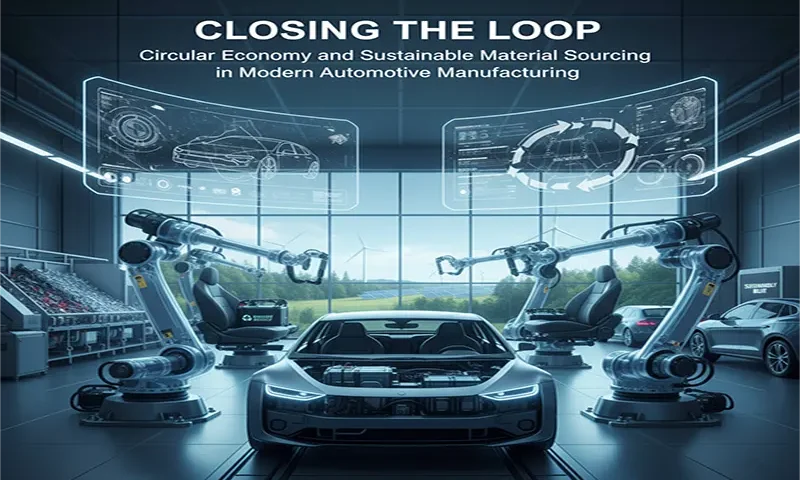
Closing the Loop: Circular Economy and Sustainable Material Sourcing in Modern Automotive Manufacturing

The automotive industry is undergoing a structural transformation. For decades, vehicle manufacturing relied on a linear “take-make-dispose” model. In 2026, however, the industry is accelerating its shift toward a Circular Economy (CE)—an industrial system that is restorative and regenerative by design. Driven by critical resource scarcity, geopolitical supply chain risks, and tightening global regulations like the EU’s evolving End-of-Life Vehicle (ELV) directives, automakers are reimagining the lifecycle of a vehicle from the ground up.

1. Design for Circularity

The foundation of circularity is established long before a vehicle hits the assembly line. Design for circularity moves beyond aesthetics and performance to prioritize the product’s entire lifecycle.

  • Modularity: Engineers are increasingly designing vehicles with modular architectures. This allows individual components—such as infotainment units or suspension modules—to be easily removed, upgraded, or repaired without compromising the integrity of the entire vehicle.
  • Mono-Materials and Recyclability: To solve the “mixed-material nightmare” that complicates
READ MORE >>>
The Tesla Insurance Advantage: A Comprehensive Guide to Protecting Your EV

Owning a Tesla is as much a digital experience as it is a mechanical one. When it comes to insurance, the traditional “set-it-and-forget-it” model is rapidly becoming obsolete. For Tesla owners, insurance is evolving into a real-time, data-driven feedback loop. By understanding how Tesla’s proprietary insurance works compared to legacy providers, you can transform your insurance from a monthly bill into a tool for financial optimization.

1. The Anatomy of Tesla Insurance

Tesla Insurance represents a fundamental shift in the industry. Traditional insurers calculate your premiums based on broad statistical demographic data—your age, credit score, and zip code. Tesla, however, utilizes real-time vehicle data to assign a “Safety Score.”

This score is calculated daily based on your actual driving habits. Factors like hard braking, aggressive turning, forward collision warnings, and unsafe following distances all contribute to your score. If you drive carefully, your “Safety Score” remains high, potentially lowering your … READ MORE >>>

The Liability Shift: Navigating Level 3 Autonomous Driving Regulations and Safety Standards in 2026

The automotive landscape is defined by a critical transition in 2026: the formalization of SAE Level 3 (L3) autonomous driving. Defined as “conditional automation,” Level 3 marks the industry’s most profound legal and technical shift. Unlike Level 2, where the driver remains responsible for the dynamic driving task, Level 3 shifts that responsibility to the vehicle—but only under specific operational conditions.

As of February 2026, the United Nations Economic Commission for Europe (UNECE) has reached a pivotal agreement on a global regulatory framework for Automated Driving Systems (ADS). This move, coupled with stringent new national standards in markets like China, signals that the era of “voluntary guidelines” is ending, replaced by mandatory safety accountability.

The Regulatory Landscape: A Global Harmonization

The UNECE’s recent announcement of a draft global regulation for ADS serves as the cornerstone for the industry. By establishing a harmonized methodology for validating autonomous systems, the UNECE aims … READ MORE >>>

The Data-Driven Driver: How to Master Telematics Apps to Slash Your Auto Insurance Premiums

For decades, your car insurance premium was largely determined by demographic “buckets”: your age, your zip code, and your credit score. If you were a safe driver living in a high-density area, you were essentially subsidizing the risk of other, less-careful drivers in your demographic.

Telematics—often referred to as usage-based insurance (UBI)—changes this dynamic. By utilizing a smartphone app or a plug-in device to monitor your real-time driving habits, insurers can shift from “group risk” to “individualized risk.” If you drive safely, you are no longer a statistic; you are an asset. Here is how to master your driving score and leverage telematics to lower your premiums.

1. The Anatomy of a Driving Score

When you install a telematics app, it begins collecting data points the moment you start your engine. Understanding what the algorithm is looking for is the first step toward optimization.

  • The “Big Five”: Most apps monitor
READ MORE >>>