
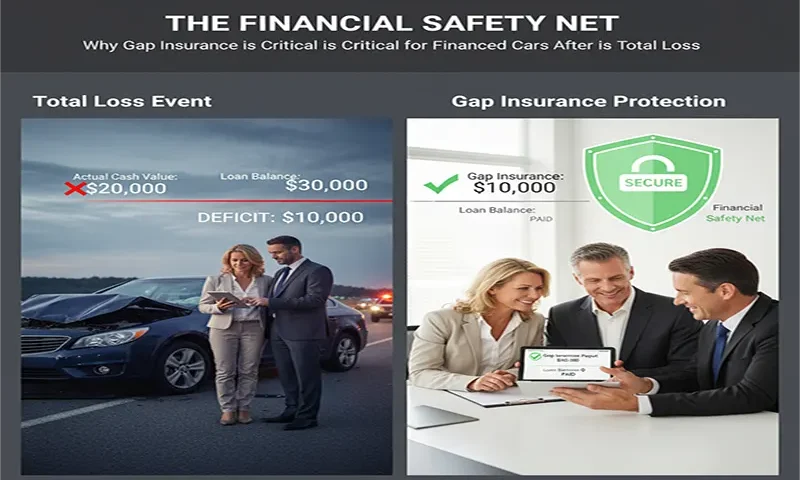
The Financial Safety Net: Why Gap Insurance is Critical for Financed Cars After a Total Loss

When you finance a vehicle, you are entering into a legal agreement to pay back a specific amount of money, regardless of what happens to the car. Many new car owners operate under the assumption that their comprehensive auto insurance will “make them whole” if the vehicle is totaled. Unfortunately, that is often a costly misconception.

If your vehicle is declared a total loss, your primary insurance provider pays only the Actual Cash Value (ACV)—the fair market value of the car at the time of the accident—not what you paid for it or what you currently owe on your loan. Because new cars depreciate rapidly, there is often a significant difference between your loan balance and your car’s market value. This is known as the “depreciation gap,” and without Gap Insurance, that gap is a debt you are legally required to pay out of your own pocket.

1.

READ MORE >>>
The Clean Slate Strategy: How New Drivers Can Secure the Cheapest Car Insurance

Securing car insurance as a new driver often feels like a paradox: you need the insurance to drive, but the cost to get that insurance is often prohibitively high. This is what many call the “New Driver Penalty.” Because insurers lack a history of your driving behavior, they view you through a statistical lens—statistically, new drivers are more likely to be involved in accidents.

However, having a clean driving record is your most valuable financial asset. It is the foundation upon which you will build your insurance history, and when managed correctly, it is the fastest way to shed that “high-risk” label and drop your premiums into the standard, more affordable bracket.

1. The Foundations of Pricing: Why You Are Rated as “High Risk”

Insurers calculate premiums based on risk probability. For a new driver, the lack of a driving record is the primary risk factor.

  • Experience Over Everything: Insurers
READ MORE >>>
The Tesla Insurance Advantage: A Comprehensive Guide to Protecting Your EV

Owning a Tesla is as much a digital experience as it is a mechanical one. When it comes to insurance, the traditional “set-it-and-forget-it” model is rapidly becoming obsolete. For Tesla owners, insurance is evolving into a real-time, data-driven feedback loop. By understanding how Tesla’s proprietary insurance works compared to legacy providers, you can transform your insurance from a monthly bill into a tool for financial optimization.

1. The Anatomy of Tesla Insurance

Tesla Insurance represents a fundamental shift in the industry. Traditional insurers calculate your premiums based on broad statistical demographic data—your age, credit score, and zip code. Tesla, however, utilizes real-time vehicle data to assign a “Safety Score.”

This score is calculated daily based on your actual driving habits. Factors like hard braking, aggressive turning, forward collision warnings, and unsafe following distances all contribute to your score. If you drive carefully, your “Safety Score” remains high, potentially lowering your … READ MORE >>>

The Data-Driven Driver: How to Master Telematics Apps to Slash Your Auto Insurance Premiums

For decades, your car insurance premium was largely determined by demographic “buckets”: your age, your zip code, and your credit score. If you were a safe driver living in a high-density area, you were essentially subsidizing the risk of other, less-careful drivers in your demographic.

Telematics—often referred to as usage-based insurance (UBI)—changes this dynamic. By utilizing a smartphone app or a plug-in device to monitor your real-time driving habits, insurers can shift from “group risk” to “individualized risk.” If you drive safely, you are no longer a statistic; you are an asset. Here is how to master your driving score and leverage telematics to lower your premiums.

1. The Anatomy of a Driving Score

When you install a telematics app, it begins collecting data points the moment you start your engine. Understanding what the algorithm is looking for is the first step toward optimization.

  • The “Big Five”: Most apps monitor
READ MORE >>>
Navigating Auto Insurance After 70: A Senior’s Guide to Finding Affordable Coverage

Reaching your 70s is a milestone that brings many life changes, from retirement to a shift in daily routines. Unfortunately, many seniors notice a common trend around this time: their auto insurance premiums begin to climb. While this can feel personal, it is important to understand that this is rarely a reflection of your individual driving history. Instead, it is a business calculation based on actuarial data.

The good news is that by taking a proactive approach to managing your policy, you can mitigate these increases and keep your coverage affordable.

1. The “Why” Behind the Rate Hike

Insurers rely on “risk curves” to set premiums. As drivers enter their 70s and 80s, statistics show a slight increase in the frequency of certain types of accidents and an increase in the cost of medical claims due to physical fragility. Because insurance is a system of pooled risk, carriers adjust rates … READ MORE >>>