
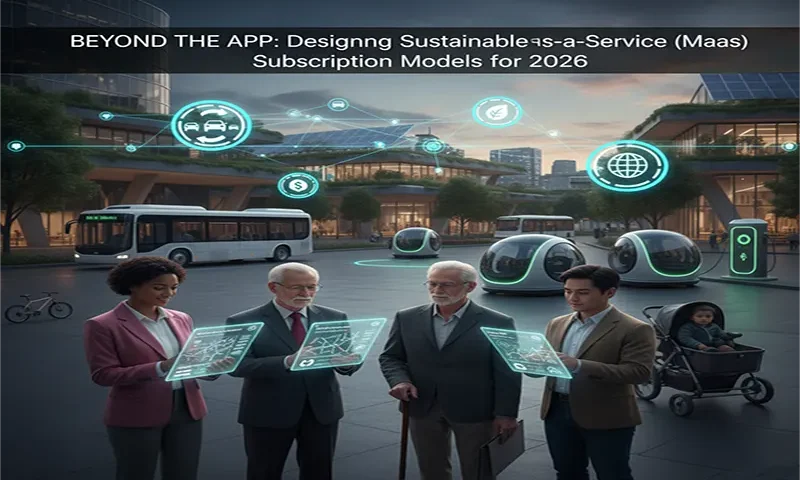
By 2026, the promise of Mobility-as-a-Service (MaaS) has matured beyond the hype of “all-in-one” apps. We have moved from the era of digital novelty into an era of economic orchestration. The central challenge today is no longer building a slick interface; it is designing a sustainable subscription engine that aligns the incentives of public transit agencies, private mobility operators, and the urban commuter.
1. The Economics of the Subscription Bundle
The core of MaaS 2.0 is the subscription bundle. However, the industry is shifting away from simplistic, flat-fee “all-you-can-ride” models, which often lead to the “cannibalization of public transit”—where high-margin ride-hailing services lure users away from the backbone of public transport.
- Bundled Subscriptions: These offer a fixed monthly fee covering a baseline of transit (e.g., unlimited metro) plus a “credit bank” for micro-mobility (e-scooters, bike-share) or ride-hailing. This incentivizes users to reserve private modes only for specific needs, such as first-mile/last-mile connectivity.
- Dynamic Pay-As-You-Go (PAYG): For commuters whose needs are inconsistent, modern AI-driven platforms offer dynamic pricing. These models adjust in real-time based on system congestion, demand patterns, and the user’s historical travel behavior.
MaaS Business Models: Fixed Subscription vs. Usage-Based
| Feature | Fixed Subscription | Usage-Based (PAYG) |
| Primary Incentive | Predictability for heavy users | Flexibility for casual commuters |
| Risk of Cannibalization | High (if not designed carefully) | Low (market-rate pricing) |
| Revenue Stream | Recurring Monthly Revenue (ARR) | Transactional (Margin per trip) |
| Data Advantage | Long-term behavior tracking | Real-time demand response |
2. The Infrastructure of Interoperability
A subscription is only as strong as its underlying technical architecture. Success in 2026 relies on Open-Loop Payments and standardized data sharing.
- Standardizing APIs: Systems are finally converging on open standards like GTFS-RT (General Transit Feed Specification – Realtime) and NeTEx. These allow MaaS providers to receive reliable, real-time data from disparate operators, ensuring the “subscription” actually works when the user reaches the turnstile.
- Open-Loop Payments: The ability to use a single digital wallet (or even a contactless credit card) across buses, trains, and shared e-bikes is the bedrock of MaaS 2.0. By removing the need for proprietary tickets, cities reduce friction and administrative overhead.
- Asset Lifecycle Management: Just as vehicles are becoming smarter, shared assets like e-scooters are increasingly tracked via “Digital Material Passports.” These track the maintenance history and component integrity, allowing operators to better manage fleet costs within the constraints of a subscription-based revenue model.
3. The Urban Impact & Social Equity
If MaaS is designed solely for tech-savvy urban professionals, it risks becoming a “luxury trap.” Social equity is not just a policy requirement; it is a business imperative for long-term viability.
- First-Mile/Last-Mile Connectivity: Public-private partnerships (PPPs) are essential here. By subsidizing the “last mile” via shared mobility credits for residents in underserved areas, MaaS can expand the reach of existing public transit, effectively increasing the value of the public backbone.
- Inclusion by Design: Cities are requiring MaaS providers to integrate non-smartphone-based access and cash-loading capabilities to ensure that residents without digital wallets or credit cards are not excluded from the future of mobility.
4. Future Outlook: The Role of AI & Autonomous Fleets
The next 3–5 years will be defined by the integration of autonomous robotaxi fleets. As Level 4 automation matures, the cost of “private” ride-hailing will drop significantly. MaaS platforms will act as the traffic controller, balancing the supply of autonomous fleets with the capacity of public transit to maximize efficiency. We are moving toward a model where the MaaS subscription will not just offer “a ride,” but will optimize the entire trip chain based on the user’s time-value and the city’s environmental goals.
The 4-Point Checklist for MaaS Integration Success
- Public Backbone Priority: Ensure all integrated services are designed to feed into, not replace, high-capacity public transit.
- API Standardization: Require all partners to adopt open, real-time data formats (GTFS-RT/NeTEx).
- Equity Mandates: Include cash-access and low-income subsidy tiers in the platform design from Day 1.
- Operational Transparency: Establish clear data-sharing agreements that benefit the city’s urban planning goals without compromising user privacy.
MaaS 2.0 is not merely a product or an app; it is an urban service ecosystem. Success in 2026 requires a fundamental shift: moving from a “tech-first” mentality that prioritizes digital convenience to a “citizen-centric” model that prioritizes systemic efficiency and social inclusion. The most successful cities will be those that manage to weave these digital threads into a single, cohesive fabric, making car ownership obsolete not because it is banned, but because it is no longer the most convenient choice.

