
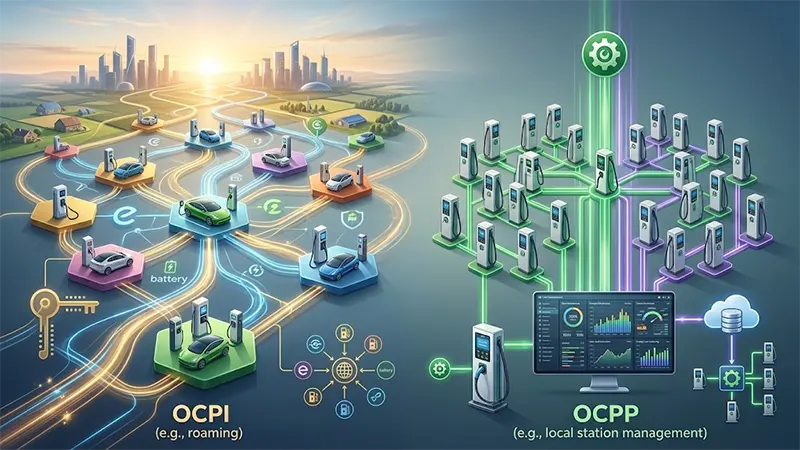
OCPI vs OCPP: Understanding the Difference
If you’ve spent any time researching EV charging technology, you’ve likely come across two similar-looking acronyms; OCPP and OCPI; often mentioned in the same breath. They are related, but they solve different problems. Put simply, OCPP governs how a charger talks to its own back-end system, while OCPI governs how different charging networks talk to each other.
What is OCPP?
The Open Charge Point Protocol (OCPP) is a communication standard used between a physical EV charger and the charging management system (sometimes called a back-end or CMS) that operates it. It allows the management system to start and stop charging sessions, receive status updates, monitor faults, and push firmware or configuration changes to the charger. Because OCPP is an open, vendor-neutral standard, it allows charging hardware from different manufacturers to work with different back-end software, instead of locking an operator into a single vendor’s proprietary system.
What is OCPI?
The … READ MORE >>>

How Professional Dent Repair Restores Your Car’s Appearance
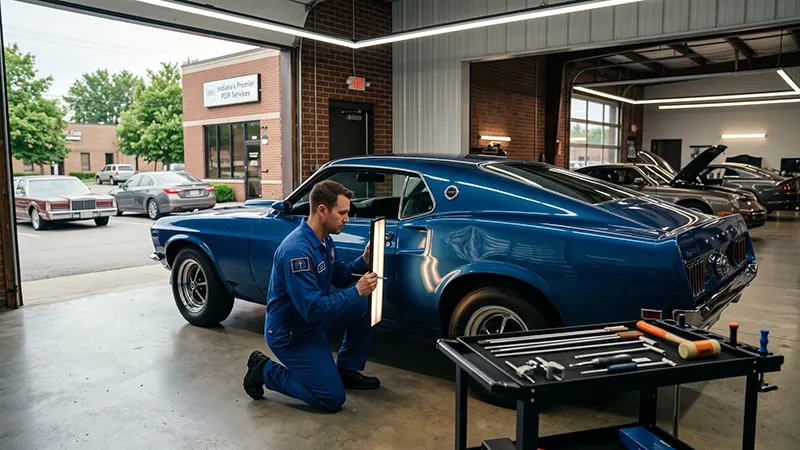
Dents and blemishes can give your car a bad appearance. Doors, fenders, hoods, and quarter panels can all be marred by minor collisions or careless door swings. A dent might appear to be a minor issue. But if it is fixed incorrectly, it could greatly affect the overall appearance of your vehicle.
Choosing the best Auto Dent Removal Service Indiana can help a lot in restoring damaged panels. The right service will do so without making a minor repair seem like a major one.
Why Dents Change Your Car’s Appearance
A dent cannot be limited to causing a shallow mark in metal. It causes a change in the way light reflects off the panel. Not to mention, it can highlight an imperfection as small as a speckle on the glass. A car might also appear to be aging and not well-maintained when its surface area is uneven.
Lines that shape … READ MORE >>>

Beyond the App: Designing Sustainable Mobility-as-a-Service (MaaS) Subscription Models for 2026
By 2026, the promise of Mobility-as-a-Service (MaaS) has matured beyond the hype of “all-in-one” apps. We have moved from the era of digital novelty into an era of economic orchestration. The central challenge today is no longer building a slick interface; it is designing a sustainable subscription engine that aligns the incentives of public transit agencies, private mobility operators, and the urban commuter.
1. The Economics of the Subscription Bundle
The core of MaaS 2.0 is the subscription bundle. However, the industry is shifting away from simplistic, flat-fee “all-you-can-ride” models, which often lead to the “cannibalization of public transit”—where high-margin ride-hailing services lure users away from the backbone of public transport.
- Bundled Subscriptions: These offer a fixed monthly fee covering a baseline of transit (e.g., unlimited metro) plus a “credit bank” for micro-mobility (e-scooters, bike-share) or ride-hailing. This incentivizes users to reserve private modes only for specific needs, such

Top Trends That Are Shaping the Car Sales Market This Year
The Australian car market in 2026 is more stable than it was during the supply shortages of recent years. Empty dealer lots and long waiting lists are far less common than they were a few years ago. Technology is a big reason why buyers have more options again. People are putting more thought into what they really need by carefully considering things like fuel costs, reliability, and how a car fits into their everyday lives.
Most people do all their homework online before they even think about visiting a showroom. They compare prices and check reviews from their phones, which has made the whole process much faster and more transparent.
More People are Going Electric
Electric cars and hybrids are becoming a more mainstream choice for Australian buyers. In 2026, they are a very normal sight on our roads. Hybrids are a popular first step for many because they save money on … READ MORE >>>

The Financial Safety Net: Why Gap Insurance is Critical for Financed Cars After a Total Loss
When you finance a vehicle, you are entering into a legal agreement to pay back a specific amount of money, regardless of what happens to the car. Many new car owners operate under the assumption that their comprehensive auto insurance will “make them whole” if the vehicle is totaled. Unfortunately, that is often a costly misconception.
If your vehicle is declared a total loss, your primary insurance provider pays only the Actual Cash Value (ACV)—the fair market value of the car at the time of the accident—not what you paid for it or what you currently owe on your loan. Because new cars depreciate rapidly, there is often a significant difference between your loan balance and your car’s market value. This is known as the “depreciation gap,” and without Gap Insurance, that gap is a debt you are legally required to pay out of your own pocket.
1.
… READ MORE >>>