

The Regional Pivot: Mapping the Localization of North America’s Battery Supply Chain in 2026
The year 2026 serves as a definitive turning point for the North American battery industry. For much of the early 2020s, the sector operated on the assumption of global efficiency—sourcing raw materials from one hemisphere, refining them in another, and assembling cells in a third. Today, that model has been replaced by a mandate for regional resilience. Driven by the U.S.-Mexico-Canada Agreement (USMCA) review, Foreign Entity of Concern (FEOC) restrictions, and the imperative of the Inflation Reduction Act (IRA), North America is executing a fundamental rebuild of its industrial infrastructure.
The Regulatory & Geopolitical Anchor
In 2020, the North American battery supply chain was a peripheral concern, largely dependent on East Asian imports for both midstream materials and finished cells. By early 2026, the landscape has bifurcated. Regulatory frameworks are no longer optional guidelines; they are the primary drivers of capital allocation.
The ongoing 2026 USMCA joint review has … READ MORE >>>


Who should setup business in UAE first time?
The United Arab Emirates stands as a prominent global hub, attracting entrepreneurs and businesses with its vibrant economy, strategic location, and business-friendly environment. For those venturing into international markets or starting a new enterprise, the UAE presents a unique opportunity. Understanding who is best positioned to setup business in UAE for the first time is crucial for maximizing success and leveraging the country’s extensive advantages. This article addresses key considerations for first-time entrepreneurs eyeing the UAE market.
Key Takeaways
- The UAE is an ideal location for diverse first-time entrepreneurs, including digital nomads, startups, and service providers seeking global reach.
- Thorough market research, a solid business plan, and understanding legal structures are essential for a successful initial setup.
- Entrepreneurs benefit from the UAE’s tax advantages, robust infrastructure, and strategic location connecting East and West.
- Free Zones like Meydan Free Zone offer simplified registration processes, 100% foreign ownership, and tax efficiencies, making

The Clean Slate Strategy: How New Drivers Can Secure the Cheapest Car Insurance
Securing car insurance as a new driver often feels like a paradox: you need the insurance to drive, but the cost to get that insurance is often prohibitively high. This is what many call the “New Driver Penalty.” Because insurers lack a history of your driving behavior, they view you through a statistical lens—statistically, new drivers are more likely to be involved in accidents.
However, having a clean driving record is your most valuable financial asset. It is the foundation upon which you will build your insurance history, and when managed correctly, it is the fastest way to shed that “high-risk” label and drop your premiums into the standard, more affordable bracket.
1. The Foundations of Pricing: Why You Are Rated as “High Risk”
Insurers calculate premiums based on risk probability. For a new driver, the lack of a driving record is the primary risk factor.
- Experience Over Everything: Insurers
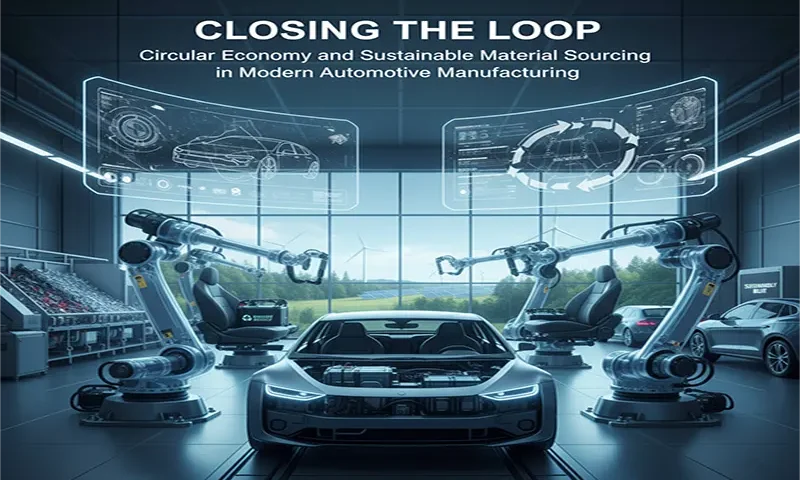
Closing the Loop: Circular Economy and Sustainable Material Sourcing in Modern Automotive Manufacturing
The automotive industry is undergoing a structural transformation. For decades, vehicle manufacturing relied on a linear “take-make-dispose” model. In 2026, however, the industry is accelerating its shift toward a Circular Economy (CE)—an industrial system that is restorative and regenerative by design. Driven by critical resource scarcity, geopolitical supply chain risks, and tightening global regulations like the EU’s evolving End-of-Life Vehicle (ELV) directives, automakers are reimagining the lifecycle of a vehicle from the ground up.
1. Design for Circularity
The foundation of circularity is established long before a vehicle hits the assembly line. Design for circularity moves beyond aesthetics and performance to prioritize the product’s entire lifecycle.
- Modularity: Engineers are increasingly designing vehicles with modular architectures. This allows individual components—such as infotainment units or suspension modules—to be easily removed, upgraded, or repaired without compromising the integrity of the entire vehicle.
- Mono-Materials and Recyclability: To solve the “mixed-material nightmare” that complicates

The Tesla Insurance Advantage: A Comprehensive Guide to Protecting Your EV
Owning a Tesla is as much a digital experience as it is a mechanical one. When it comes to insurance, the traditional “set-it-and-forget-it” model is rapidly becoming obsolete. For Tesla owners, insurance is evolving into a real-time, data-driven feedback loop. By understanding how Tesla’s proprietary insurance works compared to legacy providers, you can transform your insurance from a monthly bill into a tool for financial optimization.
1. The Anatomy of Tesla Insurance
Tesla Insurance represents a fundamental shift in the industry. Traditional insurers calculate your premiums based on broad statistical demographic data—your age, credit score, and zip code. Tesla, however, utilizes real-time vehicle data to assign a “Safety Score.”
This score is calculated daily based on your actual driving habits. Factors like hard braking, aggressive turning, forward collision warnings, and unsafe following distances all contribute to your score. If you drive carefully, your “Safety Score” remains high, potentially lowering your … READ MORE >>>