
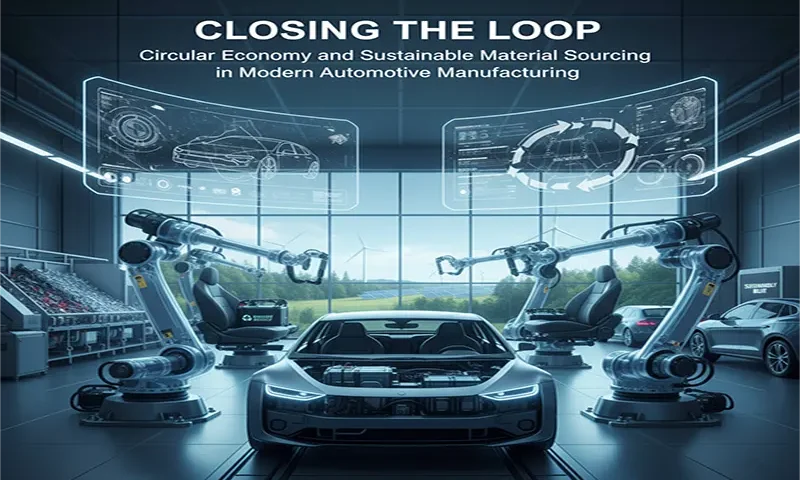
Closing the Loop: Circular Economy and Sustainable Material Sourcing in Modern Automotive Manufacturing
The automotive industry is undergoing a structural transformation. For decades, vehicle manufacturing relied on a linear “take-make-dispose” model. In 2026, however, the industry is accelerating its shift toward a Circular Economy (CE)—an industrial system that is restorative and regenerative by design. Driven by critical resource scarcity, geopolitical supply chain risks, and tightening global regulations like the EU’s evolving End-of-Life Vehicle (ELV) directives, automakers are reimagining the lifecycle of a vehicle from the ground up.
1. Design for Circularity
The foundation of circularity is established long before a vehicle hits the assembly line. Design for circularity moves beyond aesthetics and performance to prioritize the product’s entire lifecycle.
- Modularity: Engineers are increasingly designing vehicles with modular architectures. This allows individual components—such as infotainment units or suspension modules—to be easily removed, upgraded, or repaired without compromising the integrity of the entire vehicle.
- Mono-Materials and Recyclability: To solve the “mixed-material nightmare” that complicates
