
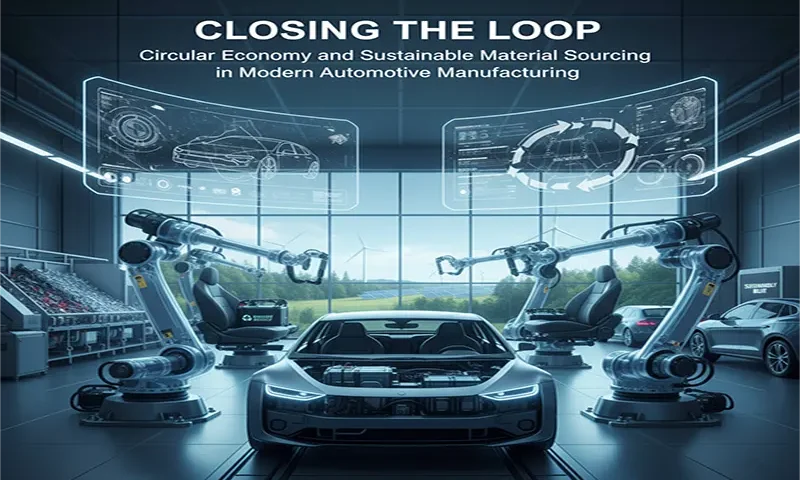
The automotive industry is undergoing a structural transformation. For decades, vehicle manufacturing relied on a linear “take-make-dispose” model. In 2026, however, the industry is accelerating its shift toward a Circular Economy (CE)—an industrial system that is restorative and regenerative by design. Driven by critical resource scarcity, geopolitical supply chain risks, and tightening global regulations like the EU’s evolving End-of-Life Vehicle (ELV) directives, automakers are reimagining the lifecycle of a vehicle from the ground up.
1. Design for Circularity
The foundation of circularity is established long before a vehicle hits the assembly line. Design for circularity moves beyond aesthetics and performance to prioritize the product’s entire lifecycle.
- Modularity: Engineers are increasingly designing vehicles with modular architectures. This allows individual components—such as infotainment units or suspension modules—to be easily removed, upgraded, or repaired without compromising the integrity of the entire vehicle.
- Mono-Materials and Recyclability: To solve the “mixed-material nightmare” that complicates recycling, designers are prioritizing mono-materials. By simplifying the chemical composition of plastics and alloys, manufacturers ensure that components can be shredded and re-melted into high-grade secondary materials rather than being “downcycled” into lower-value products.
- Digital Material Passports: Perhaps the most significant development in 2026 is the adoption of Digital Product Passports (DPP). These blockchain-enabled digital records accompany every vehicle, detailing the precise chemical composition, origin of materials, and repair history of every major component. When a vehicle reaches its end-of-life, recyclers can scan the passport to instantly identify the materials present, drastically increasing the efficiency of recovery.
2. Closing the Material Loops
Transitioning from virgin to secondary materials requires industrial-scale solutions for material recovery.
Battery Recycling and Remanufacturing
Batteries represent the most critical material loop in the EV age. As gigafactory production scrap and the first wave of high-volume EVs reach their end-of-life, the industry is scaling hydrometallurgical and direct recycling processes. These methods allow for the recovery of battery-grade lithium, cobalt, and nickel with significantly lower energy intensity than traditional pyrometallurgy (smelting). Furthermore, batteries that no longer meet the stringent requirements for automotive propulsion are increasingly diverted to second-life stationary energy storage applications, extending their utility by years.
Lightweight Metals and Green Steel
Aluminum and steel constitute the bulk of a vehicle’s mass. By integrating high-quality scrap segregation at the source—often during the stamping process at the factory—manufacturers are creating closed-loop systems where manufacturing offcuts are sent back to the smelter to be reborn as new automotive-grade sheet metal.
Polymers and Composites
Plastics represent a unique challenge due to their chemical diversity. In 2026, the focus is on chemical recycling (depolymerization), which breaks down complex plastics into their original monomers. This process allows the industry to produce recycled plastics that perform identically to virgin resins, a critical requirement for safety-sensitive automotive components.
Linear vs. Circular Automotive Manufacturing
| Feature | Linear Model | Circular Model |
| Material Source | Primarily Virgin | Secondary (Recycled) & Bio-based |
| Design Focus | Performance & Cost | Disassembly, Repair, & Recyclability |
| End-of-Life | Disposal/Downcycling | Remanufacturing & Closed-loop recovery |
| Data Visibility | Opaque (Supply chain silos) | Transparent (Digital Passports) |
3. Supply Chain and Business Model Innovation
The physical flow of materials is only half the challenge; the economic model must also shift.
- Reverse Logistics: OEMs are expanding their logistics networks to include “reverse” flows. This involves building infrastructure to collect, transport, and sort end-of-life components, often partnering with specialized dismantling firms to recover cores for remanufacturing.
- Servitization Models: Emerging “product-as-a-service” models—where customers essentially lease the vehicle’s capability rather than owning the hardware—provide manufacturers with a strong incentive to design for durability. When the manufacturer retains ownership of the vehicle, they are directly responsible for the costs of disposal, which inherently drives them to maximize the component’s reuse and remanufacturing potential.
- Collaborative Ecosystems: The transition cannot be achieved by OEMs alone. It requires deep collaboration between automakers, material suppliers, and recyclers to create standardized “material streams” that are economically viable to process.
3 Critical Material Streams for Circularity in EVs
- Lithium & Cobalt: Recovery from traction batteries to mitigate supply-chain dependence.
- Green Aluminum: Closed-loop recovery of structural casting and body panels.
- Recycled Plastics: Reintegration of polymers for interior and under-hood components.
The transition to a circular automotive economy is no longer a peripheral sustainability goal; it is a fundamental shift toward industrial resilience. By implementing design-for-disassembly, leveraging digital passports for traceability, and perfecting closed-loop material recovery, the automotive sector is reducing its reliance on virgin mining and mitigating the risks of an increasingly volatile global commodity market. In 2026, the car is evolving from a consumer product into a temporary warehouse of high-value, infinitely recoverable materials.

