
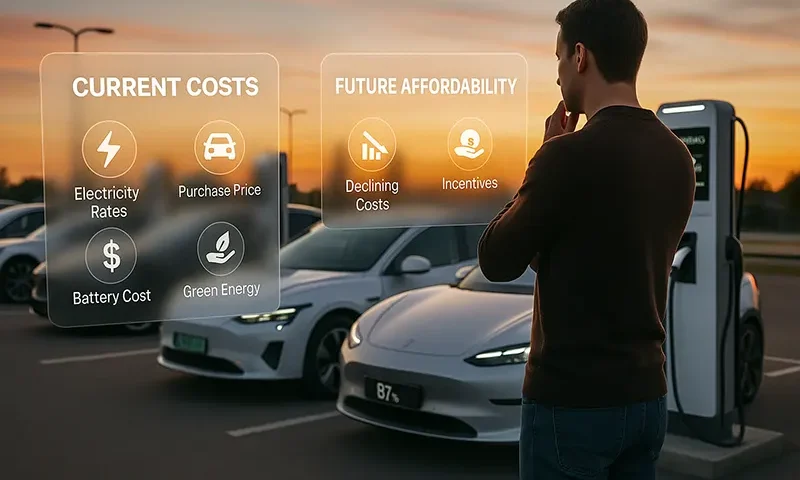
The shift toward electric vehicles (EVs) is a story of explosive growth, followed by a recent market stabilization that some prematurely call a “slowdown.” While global sales continue to climb, the industry is currently stalled at a crucial juncture: EVs are still largely a luxury for early adopters, and they must become a mass-market reality. The inevitable transition to an electrified future hinges on solving the “three A’s”: Affordability, Accessibility (Charging), and Awareness.
The thesis is clear: the EV industry must accelerate its work on the fundamentals to move beyond its current luxury segment and into the heart of the consumer market.
Barrier 1: The Cost of Entry
The primary roadblock to mass adoption remains the high sticker price. An EV still costs significantly more upfront than an equivalent gasoline-powered car, and the villain of this story is the battery. The lithium-ion battery pack represents the single most expensive component of an EV.
However, the cost landscape is rapidly changing. Global battery pack prices fell by over 25% in 2024 alone, marking the sharpest single-year decline since 2017. This decline is fueled by two major solutions:
- LFP Batteries: The increasing use of Lithium Iron Phosphate (LFP) battery chemistry—a cheaper alternative to traditional nickel-based compositions (NMC)—is rewriting the cost equation. Though LFP offers slightly lower energy density (less range), its superior longevity and lower material cost make it ideal for entry-level and mid-range vehicles. This shift is crucial for producing viable EVs priced below the key $30,000 threshold, a price point that represents a massive share of consumer demand.
- Government Incentives: While policies like tax credits and rebates have been instrumental, they are often complex and temporary. The long-term goal for the industry is to achieve true unsubsidized price parity with internal combustion engine (ICE) cars, a milestone many analysts predict will be reached as early as 2026 as battery costs fall below the critical $100/kWh mark.
Barrier 2: The Charging Conundrum
Alongside price, consumer confidence is continually challenged by the twin fears of Range Anxiety and inadequate charging infrastructure. While EV ranges have steadily improved, the public charging network remains the weakest link, leading to long waits and frustrating experiences.
The industry is responding with major initiatives aimed at boosting Accessibility:
- NACS Standardization: The widespread adoption of the North American Charging Standard (NACS)—originally pioneered by Tesla—by almost every major automaker is a significant step toward solving plug-in fragmentation. This standardization, along with government investment, is accelerating the deployment of reliable, user-friendly, Level 3 (DC Fast) chargers along highway corridors and in public areas.
- Infrastructure Growth: While Europe and China have seen massive deployment, major markets like the US are playing catch-up. The focus is not just on more chargers, but faster chargers and improving uptime, tackling the reliability issues that undermine consumer trust. The growth of public charging points is now a key metric of market health, essential for the majority of drivers who cannot reliably charge at home (e.g., apartment dwellers).
The Future of the Automotive Landscape
As the core barriers diminish, the EV market will evolve. The competition among established manufacturers (OEMs) and new players is shifting from a contest of who can offer the longest range to one focused on efficiency and software integration.
Legacy automakers are restructuring to compete on cost, streamlining production to meet demand for lower-priced models. Meanwhile, the growing supply of used EVs will soon become a critical factor. The long life cycles of LFP batteries, for instance, are making second-hand EVs a viable, affordable option for the mass market, creating an access point for millions of budget-conscious buyers and accelerating fleet turnover.
The transition is now less about if it will happen, and more about when and how smoothly the hurdles of cost and infrastructure are cleared.
Conclusion: Inevitable Momentum
Despite the current market challenges, the electric car industry is on an inevitable path to dominance. Regulatory pressure, massive capital investment from OEMs, and sustained, albeit complex, breakthroughs in battery chemistry are building momentum that cannot be reversed.
The short-term stabilization is a necessary pause, allowing manufacturers to recalibrate their supply chains and focus on cost-cutting measures that benefit the average consumer. The eventual achievement of unsubsidized price parity—likely by the end of the decade—will be the true tipping point, ending the debate and confirming the electric vehicle as the undisputed choice for the global driving public.

